An organization operating in the field of sustainable urban water management launched an applied research project dedicated to circular economy solutions.
The aim was to explore new approaches for water reuse in modern urban environments, reducing dependence on conventional water resources, and supporting the development of more resilient cities.
The project is part of the city´s plan to be energy neutral by 2035.
There is an urgent need to accelerate innovation and develop new solutions in the water sector to drive its green transition. One key element of this transformation is scaling water recycling as a core component of urban water management systems.
By reusing treated wastewater, cities can reduce dependence on limited freshwater sources, decrease environmental pressures on aquatic ecosystems, and improve overall resource efficiency.
Expanding water recycling is essential to closing the loop in urban water systems, strengthening resilience against climate change impacts such as droughts and floods, and meeting the demands of growing urban populations. As a first step, the city initiated a pilot project to assess the feasibility of advanced water recycling. The client faced several complex and strategic challenges:
This required a system capable of combining advanced treatment technologies, automation, and monitoring without rigid infrastructural constraints.


Advanced treatment and final polishing
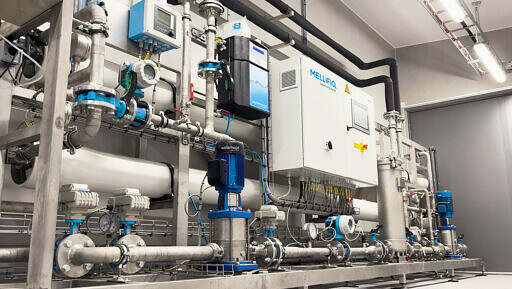
The pre‑treated water is then pumped into a second treatment process, specifically dedicated to advanced treatment and final polishing steps designed to further refine water quality. In this stage, remaining dissolved substances, organic compounds, ions, and microorganisms are systematically addressed through a combination of advanced treatment technologies.
The container is engineered to operate under controlled conditions, ensuring stable process performance and enabling precise monitoring and optimisation. This final treatment stage plays a critical role in elevating the water quality to a level suitable for drinking water evaluation. This container comprises:
The entire system operates fully automatic, with HMI control, continuous monitoring, and datalogging, making it particularly suitable for testing, evaluation, and process optimization in a pilot environment.
The pilot project enabled the client to:
Demonstrated technical feasibility
The pilot project demonstrated the technical feasibility of reusing treated wastewater for drinking water applications within a controlled research and pilot environment, validating the overall treatment concept and system design.
Achieved stable treatment performance
Through continuous operation and monitoring, the installation delivered a high and stable water quality aligned with the objectives of the research program, enabling systematic evaluation of advanced treatment stages and process interaction.
Enabled flexible and safe pilot operation
The modular and containerized setup provided a safe, robust, and highly controllable system, well suited for laboratory and pilot use, allowing flexibility in operation, adjustment, and optimisation under varying conditions.
Generated valuable knowledge and data
Long‑term operation and structured monitoring established a solid base of operational knowledge and performance data, supporting informed analysis and comparison of different treatment configurations and operating strategies
Supported future full‑scale evaluation
The project created a strong foundation for assessing the potential of future full‑scale urban applications, providing insights relevant for scaling, design optimisation, and integration into broader water management systems.
Contributed to sustainable water management
Overall, the project represents a concrete step towards more sustainable water management models, supporting the transition to circular, resilient, and resource‑efficient cities through advanced water reuse concepts.